The Presence Protocol in Action
What it looks like when load smoothing works — and what happens when you skip it

How can I be more present with my kids?
This is one of the most common questions I get asked. Most parents have heard some version of “enjoy every minute.” Most have also experienced the guilt of realizing they missed their kids’ comments while saying “uh-huh” and scrolling on their phone, or waiting all day to get home to be with their kids, just to experience a mad dash through the daily grind and toward bedtime.
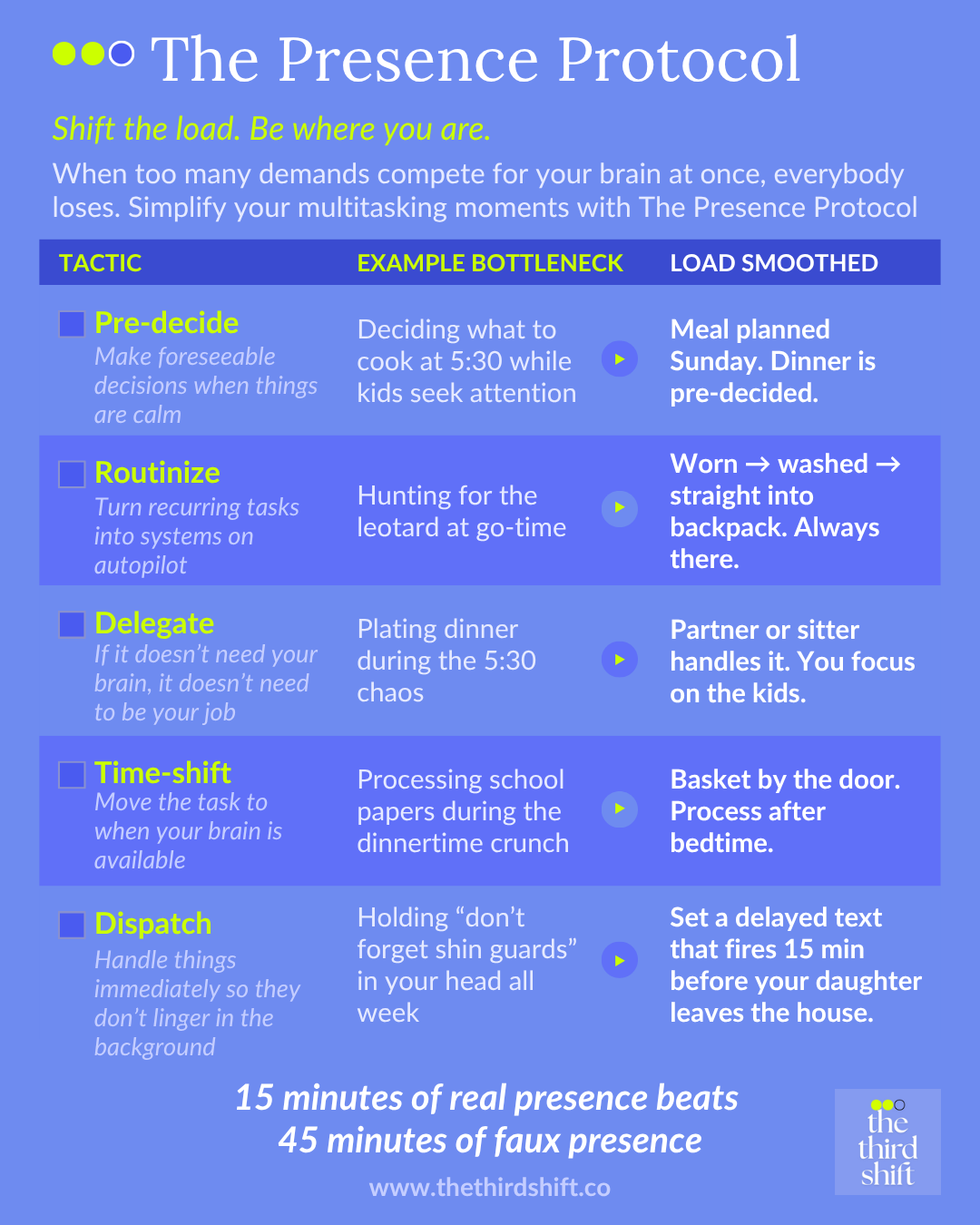
Earlier this week I introduced The Presence Protocol — a method for shifting cognitive load away from peak family times so you can be fully present when it matters most. The core technique is load smoothing: spreading demands across calmer moments so each time block can come closer to serving a single purpose.
That’s the framework. Now let’s see what happens when you use it — and what happens when you don’t.
Marisol’s 30-minute shift
Marisol told me that her evenings were the biggest stress. She wasn’t sure precisely why, but together we identified the root cause: she always imagined her family would eat together at family dinner, but now that she and her husband had a child, it rarely happened.
Marisol looked forward to reuniting with her son each day after work, so she went immediately to pick him up at 4:30 even though her nanny share ended at 5:00pm. When they returned home, her son was fussy and hungry, and Marisol ended up giving him snacks while she prepared dinner. She wasn’t able to play or deeply engage with him since she was busy with meal prep.
The result? Her son was too full to eat dinner and ready to go to bed, so she and her husband ate in shifts while they alternated childcare.
Despite doing meal prep on the weekends and rushing to pick up her child as early as she could, Marisol was feeling guilty, missing out on connection, and believing she had failed every day.
The Solution: Be 100%
As an outsider, it was easy for me to see that Marisol’s goal — quality family time — could be met, paradoxically, by picking up her son later. The reframe: 30 minutes of connection is better than 60 minutes of being frazzled, frustrated, and ignoring each other.
We did an experiment. For one week, instead of picking up her son at 4:30, Marisol picked him up at 5pm. She used the 30 minutes alone at home to put dinner on the table, so her family can sit down immediately upon returning home from daycare pickup.
After four days, Marisol said: “It’s really working, and it feels so much calmer.”
Now, instead of trying to keep her son busy while she stresses in the kitchen, Marisol focuses 100% on making dinner (which she enjoys), and then 100% on connecting with her family while they eat it.
Ultimately, she made just this one change, which cost her nothing but is paying significant dividends in calmness, quality time, and joy.
Think about your own worst bottleneck time. What’s competing for your brain, and what could you move? There’s an exercise to help you think this through here.

What happens when every block has one job
Last weekend I was reminded of how powerfully this works. My husband was away and I was solo parenting two children under age 5 all weekend. And we had so much fun! I was exhausted by 7pm, but deeply enjoyed my children. And they had fun too. (I’m discounting the moment at the playground when both were clinging to my legs and crying simultaneously — this is reality, after all.)
Because I was parenting alone, I didn’t expect to have time to do anything “productive.” As a result, I was never trying to distract my kids or ignore them to complete some task. I was present 100%, making eye contact when they glanced up from play, singing silly songs while I put together their snacks, sitting on the floor for our tea parties.
I’m not saying you have to be “on duty” all weekend for this to work — it’s totally fine to trade off with another adult if you need to step away. What I’m saying is, as much as you can, be “all in” one thing at a time.
That’s what single-tasking is: not a demand to do less, but an effort to do one thing at a time.
(And yes, you can sometimes involve your children in single-tasking on “productive” things like cooking… but usually not on family admin or knowledge work.)
What happens when you don’t
Here’s the flip side. My husband and I noticed that we experience more irritation with each other when one of us is physically present but not mentally present — sitting in the living room with the family while immersed in work e-mails or Slack messages.
So we’ve recommitted to removing ourselves from family spaces when we need to focus on work. Because being 100% whatever you’re doing — whether it’s work, organizing, working out, or playing — is better for your brain, your productivity, your stress levels, and your relationships.
The Presence Protocol isn’t just about being present for your kids. It’s about reminding yourself that if your brain is elsewhere, your current moment isn’t actually connection time — even if you’re in the same room.
Fifteen minutes of true engagement is better than 45 minutes of faux presence.
Fifteen minutes of true engagement is better than 45 minutes of faux presence.
The research backs this up: Indiana University School of Medicine found that just 15 minutes a day of focused, child-led attention can reduce negative behavior and strengthen your bond.
It’s not about more time. It’s about single-tasking when you’re there. So go work efficiently for 30 minutes, then come back and spend 15 minutes deeply engaging. Everyone will feel the difference.
Think about the last time you were physically with your family but mentally somewhere else. What would it look like to give that time a single purpose? This is “quality over quantity” in action, and it works.
Warm wishes,
Jennifer