

You’re not imagining it — your mental load is growing.
Institutions are dumping work on you, and no one’s stopping it. Here’s how to tame Parenting Administrative Scope Creep.

Seven apps for interacting with one elementary school. The need to devise and establish a “screen time” policy. Choosing time to talk to your kids about the profound risks bound up neatly in the “AI may make mistakes” disclaimer.
These are just a few of the ways that technology is contributing to the death-by-a-thousand cuts mental load parents carry.
The Rise of Parenting Administrative Scope Creep
Information overload and compounding daily frictions are driving the mental load to new heights. Both are a result of the steady transfer of administrative work from institutions onto individuals.
That transfer is systematic. In the name of efficiency and cost savings, institutions pay gobs of money to build systems that offload their frictions onto individuals, who have little to no say in the matter.
And, it really is increasing. Here’s a proxy: in 2026, the average person handles 120 personal and 67 work-related passwords, a 134% increase over 2020.¹ For parents, that compounds — you carry those logins for medical providers, schools, and activities on your kids’ behalf as well as your own.
I think of it as Parenting Administrative Scope Creep. You signed up to raise human(s), and implicitly accepted certain things: taking them to the doctor, getting them to school, signing them up for the activities they love. Parenting Administrative Scope Creep is the burgeoning workload bolted onto those agreements since — the logins, forms, portals, and tracking and monitoring that keeps expanding.

Parenting (and individual) Administrative Scope Creep shows up everywhere once you start looking for it. Here are a few examples:
Before: A weekly school newsletter printed on paper that our mothers could file away to read in one sitting at a convenient time.
Now: Seven apps, each with its own login, hard to hand to anyone else, fragmenting the information and peppering you with interruptions.
Before: The receptionist hands you a clipboard with paperwork — a contained task completed at a dedicated time within the dedicated context of the medical visit.
Now: They interrupt your day with a link you’re supposed to switch contexts to and set aside time to complete before you arrive.
Before: You talk about what is wrong and the provider (or their assistant) records it based on visit notes.
Now: You’re expected to perform the cognitive labor of translating your words and logic into someone else’s information hierarchy, plus perform tedious data entry: reshaping your thoughts into checkboxes and drop-down menus.
Before: You’d get a letter in the mail or a phone call with test results.
Now: You must remember passwords, usernames, login links, and the to-do of going into the portal afterwards to check for results and visit notes.
Parenting Administrative Scope Creep Isn’t Just Annoying — It’s Costly
Here’s what makes it so maddening: every touchpoint with a third party seems to leave you with more to carry, not less.
You sit down to cross one thing off — book the pediatrician — and instead of shortening your list, the appointment spawns three new tasks and a sprinkling of interruptions: download the app, create the login, fill out a questionnaire, print a school form, create a calendar hold, alert your co-parent, reply to confirm your visit, complete the pre-visit form by Tuesday.
All of this costs us cognitively — from interruptions and task switching, to the increased imperative for “monitoring,” to the need to screen a surge of spam messages in every channel so we don’t miss the important ones mixed in, to being forced to make micro-decisions about translating your reality into another entity’s information architecture.
As with so much that composes the mental load, it is easy to feel like each of these moments is too small to mention — because each one is small. A two-minute form. One more password. A single notification. But the collective load is enormous.
You Don’t Have An Advocate, So You Have to Be Your Own
The cost of this admin burden is real enough that economists, behavioral scientists, and entire governments have given it names and built programs to push back against it.
What I call Parenting Administrative Scope Creep is what economists call administrative burden2, what Cass Sunstein calls sludge3, what writer Craig Lambert calls shadow work4. An administrative burden-reduction movement does exist — but it’s pointed at government paperwork, not private institutions.5
Harvard Law professor Cass Sunstein has argued that firms and public institutions alike should regularly conduct sludge audits to catalogue and reduce these costs. But at home this admin burden is just accepted as part of life — the drudgery part of life that typically lands on women by default.
When it comes to the workload of family life, there’s no voice rallying against the growth of “sludge for parents.” Until there is, the load will keep growing.
What can you do?
One of the worst parts of this is that you have very little power in these transactions. But there are a few ways you can push back against these demands — and it’s worth trying to. They sap your time and fragment your attention, and those are the most precious resources you have.

Consciously protect your time, attention, and calm
First, let the idea that this is genuinely a lot of work sink in. I’m highlighting it so you can read it again. Give yourself permission to get help with it. There’s no gold star coming for martyring yourself at the altar of doing it all alone.
Discuss it with your partner (if you have one). Ideate around how to reduce or spread the load — more below.
Take steps to (a) stem the volume of inbound information and (b) use systems for sharing the load. Here are some ideas:
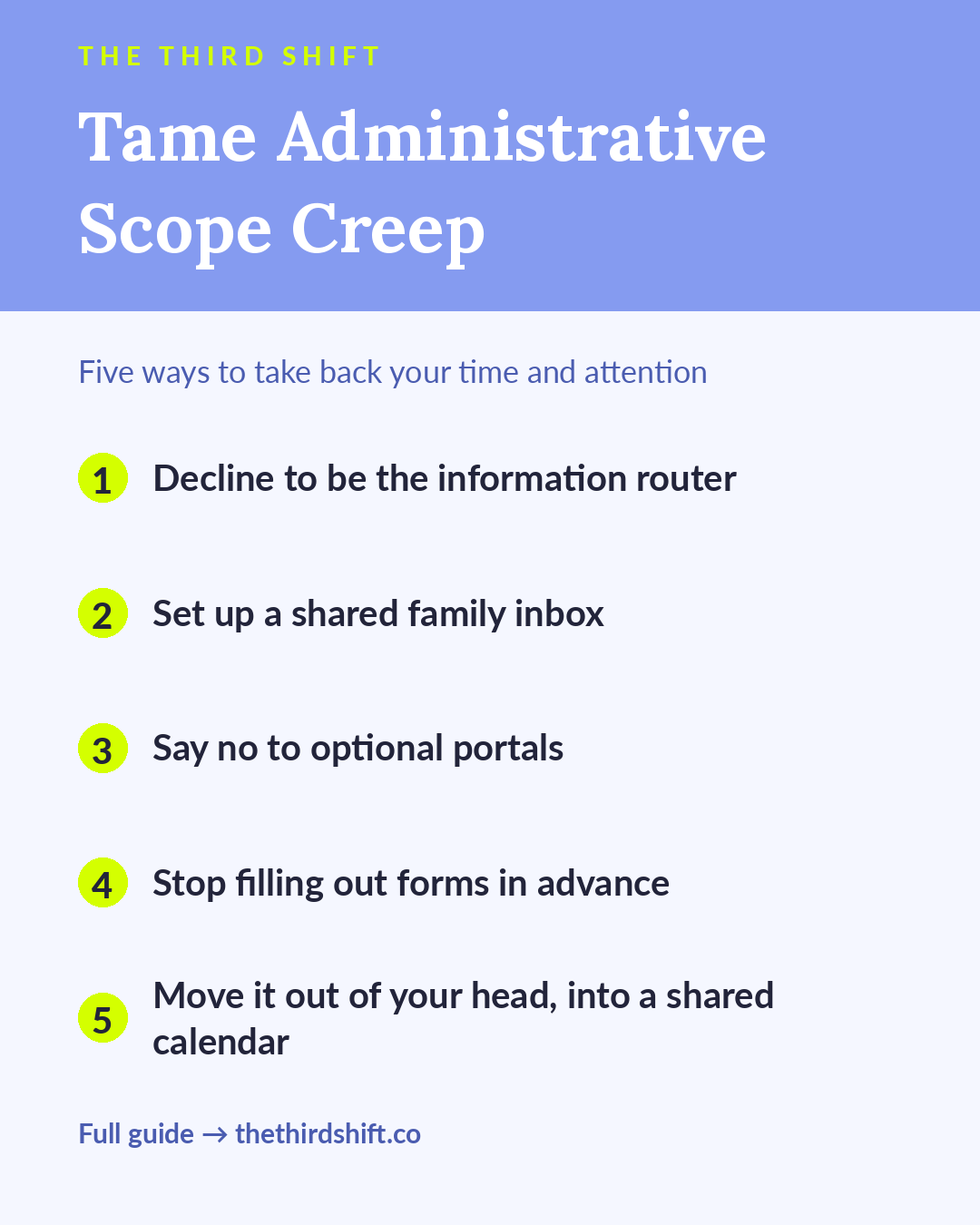
Stem inbound information and use systems to share it
Decline to be the information router.
Ensure that messages other adults may need are group texts with those adults. When I text our nanny, I always include my husband, even if he’s out of town. That way, he’s not asking me four days later whether the ballet outfit has been washed — he has seen the text exchange with the nanny, and he knows.
Share it with your partner and any other supporting adults in your life — whether that’s your mother, an au pair, or a paid family assistant. If you can, delegate full responsibility for monitoring the inbox to someone else.

Opt out of notifications and communications that aren’t essential.
Aggressively unsubscribe from anything you aren’t excited to open right away. (This also results in fewer impulse purchases.)
Decline to give out your phone number
It’s often not required even when businesses ask for it. Send a “STOP” reply to text alerts you aren’t genuinely glad to receive.
If using a business’s “portal” is optional, decline.
No thank you to passwords, log-ins, and navigating others’ information hierarchies. Yes to communication in the mediums you already use (like your email account). Don’t assume you must use the portal. Ask.
View requests as just that, and not as requirements.
Consider whether they serve you. I don’t fill out forms in advance anymore; I wait until I’m at the business, and I use their iPad, not my own phone. This protects my attention before I get there, and keeps me from having to give out my phone number while I am there.
Move information out of your brain and into low-friction places.
For me, it’s a Google calendar. I put all the information I may ever need about something there inside a calendar hold. That way, it’s front-and-center for me exactly when I need it (no searching thousands of emails or scrambling last-minute for contact information or portal sign-in links). I invite any supporting adults — husband, nanny, friends, babysitters, grandparents — to the calendar hold so I’m not responsible for reminding or informing them.
Invest in real support.
If it’s feasible for you, delegate the load itself — the monitoring as much as the tasks — to another capable adult: a partner who fully owns a domain, a family member, or a paid service.
Can I hand this to AI?
An obvious question is whether AI agents will absorb this load.

Can AI Lighten the Mental Load? A Conversation with Danielle Matarasso, Founder of AI After Carpool
In theory, they should — a well-built agent could monitor the inboxes, fill the forms, hold the calendar. In practice, I haven’t seen it deliver real relief: someone still has to build the agent, manage it, and check its work, and that someone is usually the same person already carrying the load. For now, I’m watching closely — and still delegating to humans. Paid subscribers can see everything I delegated to my family assistant in 13 months here.
What kinds of Parenting Administrative Scope Creep have you experienced? How are you pushing back or streamlining the load? Reply and let me know.
JULY 16 | Join Me for a Virtual Panel on Parenthood, Burnout & the Mental Load

July 16 | 12:00 PM ET | Virtual Event | RSVP here
Join us for an honest conversation about the mental load of parenting, burnout, asking for help, and creating more time and space for yourself.
Hope you’ll join us!
Warmly,
Jennifer
Sources and concepts referenced:
¹ NordPass, “How many passwords does the average person have?” (2026).
2 Pamela Herd & Donald Moynihan, “Identifying and Reducing Burdens in Administrative Processes” (The Regulatory Review), drawing on their book Administrative Burden: Policymaking by Other Means.
3 Cass Sunstein, “Sludge Audits” (Behavioural Public Policy, 2022).
4 Craig Lambert, Shadow Work: The Unpaid, Unseen Jobs That Fill Your Day (via Harvard Magazine).
5 Organizations working to reduce externalized friction:
So true! I feel like is a big issue for aging seniors as well, watching my parents navigate all the medical portals and banking log-ins which causes a lot of stress.
Even with my medical provider Ive opted out. They can call. Im just done with all of it.